Against Wine Elitism
A caution against comfort with the language of elitism and a defense of the mystery in ordinary things.

.jpg)
Over the last couple of weeks, I’ve noticed a trend in the wine media ecosystem: a defense of “elitism” in wine. Some of this has been in the wake of Caroline Lamb’s essay “Gen Z to Wine: Please Stop Condescending to Us,” published in Jason Wilson’s newsletter EVERYDAY DRINKING. That piece was mostly a rejoinder to an article in Wine Spectator on the supposed drinking habits of Gen Z. I thought that piece was generally very good. I’m not much older than Lamb, and I run into the same problems of affordability that she describes in that article.
However, I do worry a bit when I start to see this discussion about not “dumbing down” wine turn into a justification for elitism in wine, where we start talking about “meeting at the bottom” versus “inviting up.” Anti-intellectualism is one of the dominant paradigms of our day; we live in a world where a significant number of people think that expertise is inherently evil. This is bad, of course. But we ought to be really careful about slipping into reaction on this topic. We don’t need to start believing that hierarchies are good, actually, in order to reject anti-intellectualism.
Jim Silver’s essay “Wine Isn’t Suffering from Elitism” is a quite clear version of this defense of wine elitism, and so, in the rest of this essay, I’ll address it directly as a means of talking through why I think we ought to be more careful with the language of elitism. My thesis here, to be up-front about it, is twofold: (a) that defending elitism risks reinforcing traditional hierarchies of value in wine, and (b) that elitism mistakenly conflates itself with “complexity” and “mystery,” when those two things are just as much—and possibly moreso—the providence of the ordinary.
The thesis of Silver’s relatively short essay is straightforward: that in pursuing accessibility wine has relinquished its cultural superiority, and that any decline wine is facing right now is a direct consequence of that abandonment. In contrast to other beverages, like beer, hard seltzers, and canned cocktails, wine is not, and has never been, a “casual” beverage. The industry has chosen the path of increased casualization, and once placed in that position, wine doesn’t have a chance. It’s simply not able to “out-casual,” in Silver’s words, these other drinks. The idea of wine’s superior position is based on two main premises: that “complexity creates meaning” and that “mystery creates value.” Accessibility vacates complexity and mystery and, consequently, meaning and value. And, thus, he concludes: “wine is not dying because it is too elitist. It’s dying because it made itself ordinary.”
I want to start by focusing on Silver’s list of what he considers to be the things that give wine its superiority:
Wine once, and still does, occupy a unique cultural role. To know it was to enter a world of history, geography, art, geology, botany, chemistry, and craftsmanship. The language of appellations, terroir, and vintage did not exclude—it inspired, especially those who chose to embrace it. Wine was (is) a code, and those who learned it joined a centuries-old conversation spanning the entire world. Like music, the language of wine is unifying.
So, for Silver, wine is a locus of a bunch of different fields of knowledge. I don’t disagree here: I’m continually impressed at how deep the well of knowledge in wine can be; there’s so much it’s possible to learn. That said, I start to hesitate a bit when I read that wine’s language “did not exclude—it inspired.” To take the obvious example, Burgundy, the way we talk about terroir in that region is absolutely exclusionary. It thinks so itself. Burgundy’s value proposition is that its wines are an absolute expression of place, simultaneously perfect and infinitely variable (justifying the range of its subdivisions). Its wines can be enormously expensive because there simply is no alternative to its terroir, which is optimal; nothing else can measure up.
The next sentence, though, is where I transition from hesitation to full disagreement. Silver says: “wine was (is) a code, and those who learned it joined a centuries-old conversation spanning the entire world.” This is a fundamentally conservative line of argument. It’s identical to the argument that learning the classics of the western canon is “unifying.” There might be a “centuries-old conversation spanning the entire world,” but what, exactly, are the boundaries of that “entire world?” How does the “conversation,” understood in this way, act if you probe its boundaries?
I saw an Instagram post the other day where someone asked for tips from Toru Takamatsu (the world’s first Japanese Master Sommelier, in addition to being the world’s youngest) on taking the MS exam. He gave a couple of suggestions, but the one I want to highlight was #4: “4. Theory goes wide, not deep. 60 to 70 percent of questions sit at Certified plus a bit. Burgundy is the only region where cru and lieu dit detail is expected.”
Perhaps talk of terroir is a conversation that spans the entire world, but that language has a hierarchy, and within that conversation some places are presumed to matter more than others. Much of the truly “code”-like language we have in wine is designed around France broadly, places like Bordeaux and Burgundy specifically, and focuses on the particulars of high-end production concretely: the 1855 Classification; Burgundy’s crus and lieux-dits. Just as in literature, there is a canon in wine.[1] Perhaps classic French wines have that language because they are simply the best wines; perhaps not.

Don’t get me wrong: I think wine can be complex and mysterious, and I value those things. I said so in my post last week. But I do not agree that accessibility debases complexity. I do not agree that mystery and ordinariness are at odds. In fact, I think that wine is at its absolute best when its mystery and complexity are ordinary. In my post last week, I said the following:
Human beings are learning creatures; we change, we grow. We do that by confronting difficulty.
The important part of that second sentence is not “difficulty.” It’s “confronting.” Human meaning is made not merely by being in the presence of something deemed “elite” or “powerful” or “difficult”—it emerges from the confrontation with difficulty, whatever that might be. The thing you’re confronting? It can be anything. It can be DRC (and the fact that for a substantial number of people I don’t have to explain what that acronym means is telling) or it can be a homemade wine made from a backyard vine in Georgia. Oftentimes, the things that matter the most are the things we encounter every day.

Let me share an example.
I’ve spent a lot of my life studying philosophy, and especially the liberal dissident philosophies that emerged in the satellite states[2] of the Soviet Union. One of the things I’ve always admired about this philosophical tradition is how tangible it is: ideas and concepts were not merely knowledge or part of a “conversation” but lived action. Václav Havel, who was a poet, playwright, philosopher, and ended up being the first president of free Czechoslovakia (and subsequently Czechia after the split) and is one of my favorites, called this reality in a famous essay of his the act of “living within the truth.” Philosophy of the highest order could be found on a street corner, or in a mug of beer.[3]
This tangibility isn’t exclusive to these latter-day philosophies, of course; you can find them all over culture from that part of the world. If you’ll tolerate some theology for a moment, the ritual practice of Eastern Orthodoxy is another example. That faith does not draw a distinction between the body of Christ in heaven and the body of Christ on earth (the church), and so worship tends to be both continuous and multisensory. Services are usually chanted by the whole congregation front-to-back and include physical actions (switching between standing, kneeling, and bowing), scents (incense, candles, scented oils), and significant amounts of eating, all of which are considered expressions of communion with God.
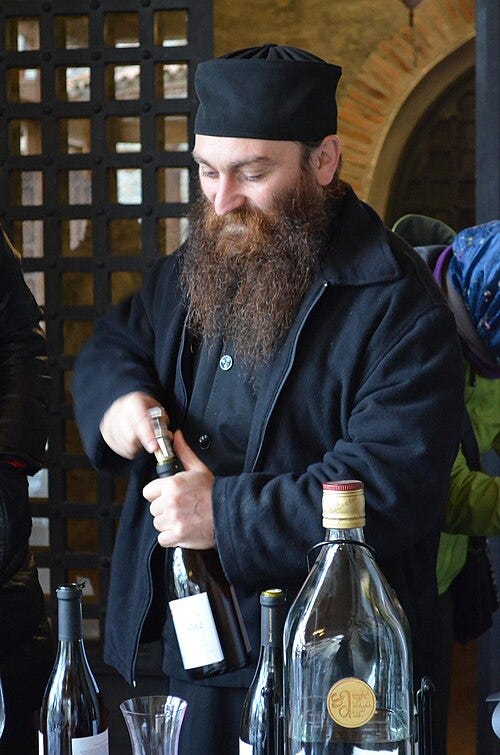

This spiritual physicality, as you might imagine, extends to wine. In the 60 Minutes piece on Georgian wine from a few years back, the bishop of Alaverdi Monastery—an iconic building in Kakheti, and home to a substantial cellar and winemaking operation—says that “whenever we are in the vineyard or the wine cellar, we always feel that God is close to us.” Lisa Granik reinforces this when she notes that, in the Georgian imagination, “wine serv[es] as a metaphor for Georgia (the birthplace of wine), for Georgians (whose blood is wine), with a religious overlay (the blood of Christ).”[4] In Georgia, wine is everywhere, in every part of culture and life, and yet is mysterious and complex all the same. In fact, it’s sacred not in spite of being ordinary, but because it’s ordinary. It is the presence of God in all things.
Sometimes I think that those of us who work in wine, especially on the theoretical side of it, forget that we’re talking about peoples’ lived realities when we talk about “appellation, terroir, and vintage.” Our knowledge, the thing that supposedly justifies our “elitism,” is made up of places where real people live their lives. What right do we have to say that we have some sort of “centuries-old conversation” that they’re welcome to join only if they “embrace” our language? Why do people need to come “up” to where wine is? Why does wine have to be elite to be beautiful?
And, sure: we can say that when we say elitism, we don’t mean that elitism, we just mean caring about place and terroir and history. But it simply isn’t that easy. If it were, we wouldn’t see hierarchy language continually creeping in, the language of ups and downs and codes and insider cultures. This problem is hard. Figuring out how we can purge wine’s traditional hierarchies from our language of place, how we can celebrate wine’s history and complexity everywhere, is a challenge that all of us on the progressive side of the industry are obligated to face. It starts with embracing the mystery in the ordinary.
[1] This great new post by Sara Danese on EVERYDAY DRINKING goes into this more: “I Looked at 1,000 Wine Lists. The Data Says the State of Fine Wine is Boring and Overpriced.”
[2] Or the “SSRs,” the “Soviet Socialist Republics” that served as the second-tier unit of government in the Soviet Union, other than Russia.
[3] One of Havel’s key examples of how dissidents are made is the case of Š, a brewer whose commitment to making high-quality beer made him a target of Soviet systems of discipline. See pp. 43-44 of the linked pdf.
[4] The Wines of Georgia, p. 43.
Fantastic piece. So much good stuff here. I think the “wine is not, and has never been, a “casual” beverage” idea completely falls apart when you step outside of an Anglo-American POV. My lived experience in Spain tells me that up until recently wine was THE casual beverage, and still is in regions like Rioja where you go out to Calle Laurel for a pintxo and wine is quite literally cheaper than beer.